

Training
7 Things Dog Trainers Won't Tell You About Why Your Dog Ignores Every Toy You Buy
Eleven years of training dogs. Twenty-three toys in my own basket. One chewed skirting board. These are the seven things I started looking at differently.
If you read my story about Bruno, you know the short version. Eleven years of telling clients to walk more and buy more toys. Twenty-three toys in a basket at home. A chewed skirting board in my own hallway.
Here's the long version. The seven things I should have been telling people all along.
1. Why more exercise wasn’t enough
The question I started asking: what does Bruno do after the walk?
"Walk him more" is the first thing every trainer says. I said it for a decade.
It works for a few weeks. Then two things happen. The dog gets fitter, so the same walk does less. And the owner runs out of hours in the day.
By month two, the client is doing two walks a day, sometimes daycare on top, and the dog is still eating the house. They come back to me feeling like they've failed. They haven't. The advice has a ceiling and they've hit it.
Here's what I didn't understand for a long time. A walk tires the legs. It doesn't touch the part of a dog that wants to hunt. You can walk a dog until it lies down and it will get up twenty minutes later with the same itch it had before.
Bruno was the proof. Two walks a day, an hour each. He came home panting, slept, then stood up and went looking for something to do with his mouth.
2. The toys waiting for a human
Look at what happens when you put the toy down.
Tip your toy basket out on the floor. Sort everything into two piles. Toys that move on their own, and toys that wait for a human.
I did this with Bruno's basket. Twenty-three toys. Twenty-three went in the second pile.
A rope is a stick until someone picks it up. A plush toy is a pillow. A tennis ball is a ball on the floor. A puzzle feeder is interesting until it's solved, which for most dogs is day four.
I call them passive toys. They only fire a dog's brain while you're standing there operating them. The moment you leave the room, they turn back into furniture.
And here's the bit that stings. The problem behaviour, the chewing, the barking, the pacing, almost always happens when you're not there. So the toys you've bought are switched off at exactly the moment your dog needs them switched on.

3. When the game gets predictable
Variety became the thing I looked for.
Every dog carries the same sequence, whether it's a working kelpie or a lounge-room pug. See. Stalk. Chase. Grab. Shake. Trainers call it the prey sequence.
A dog's brain lights up for movement it can't predict. That's what "see" is really about. Something moved, and the dog doesn't know where it's going next.
A ball rolling in a straight line is predictable after two goes. A squeaky toy squeaks the same way every time. Once your dog can predict a toy, the sequence never starts, and the toy goes in the basket.
Owners tell me "he's just not a toy dog." I've never met a dog that wasn't. I've met a lot of dogs that had already solved every toy in the house.
When the chase drive has nowhere to go, it goes into the house. Cushions. Skirting boards. The back door. Your shoes. Your dog is not being naughty. They are under-stimulated.
4. The gaps between throws
Fetch is a shared game. I was looking for another kind of play, too.
This is the one clients push back on. "But we play fetch every day."
Think about what fetch actually is. You throw. The ball flies in an arc and lands. The dog runs in a straight line, picks it up, brings it back, and waits for you to throw again.
That's three seconds of chase, then a wait. And the chase itself is the most predictable movement there is. The dog knows where the ball is going before it lands.
Real prey doesn't fly in an arc. It zigzags. It stops dead. It bolts the moment it's touched. That's what runs the whole sequence, from stalk to grab to shake, and that's what leaves a dog properly satisfied.
Fetch is a good time. I'm not telling you to stop. I'm telling you it's not doing the job you think it's doing, and it needs you standing there for every throw.
5. My five-point toy checklist
Five questions to take to your own toy basket.
Once I understood the problem, the fix seemed obvious. Buy something that moves on its own.
So I ordered a self-rolling ball off Amazon. It rolled in a straight line at one speed, and it stalled on my carpet in about ninety seconds. Bruno sniffed it and walked off.
Then I did the thing I tell clients not to do. I assumed I'd bought a dud and ordered a second one. Same result.

The cheap balls have three faults. Straight lines, so the dog predicts them. One speed, so there's no stalk and no bolt. And no grip, so they die on the surface most Australian lounge rooms actually have.
After that I wrote down five things a toy has to do before I'd recommend it to a client.
Nothing in Bruno's basket got past the first question. The Amazon balls got one out of five.
6. The toy I tried next
Here’s how the features fit the checklist.
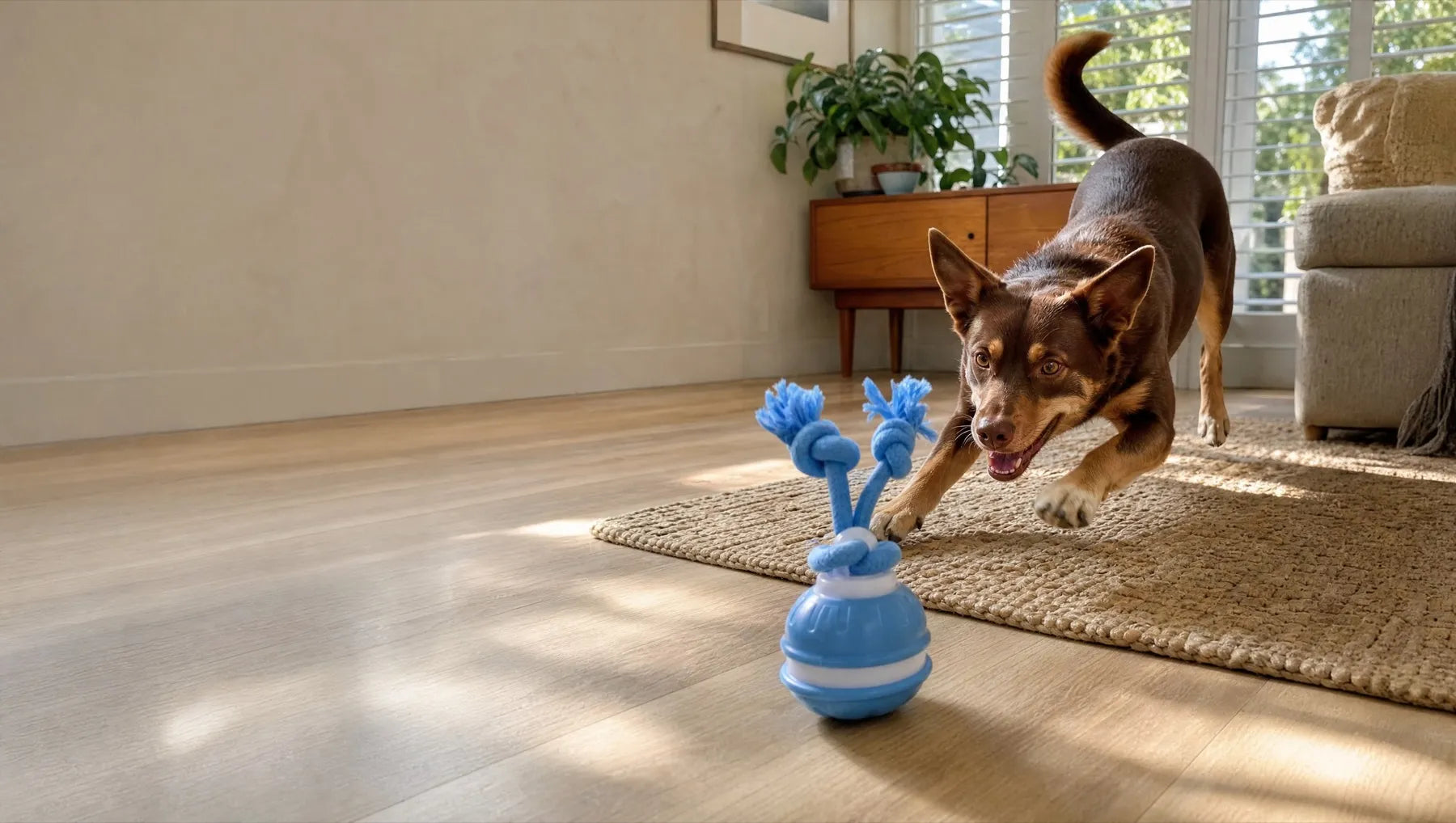
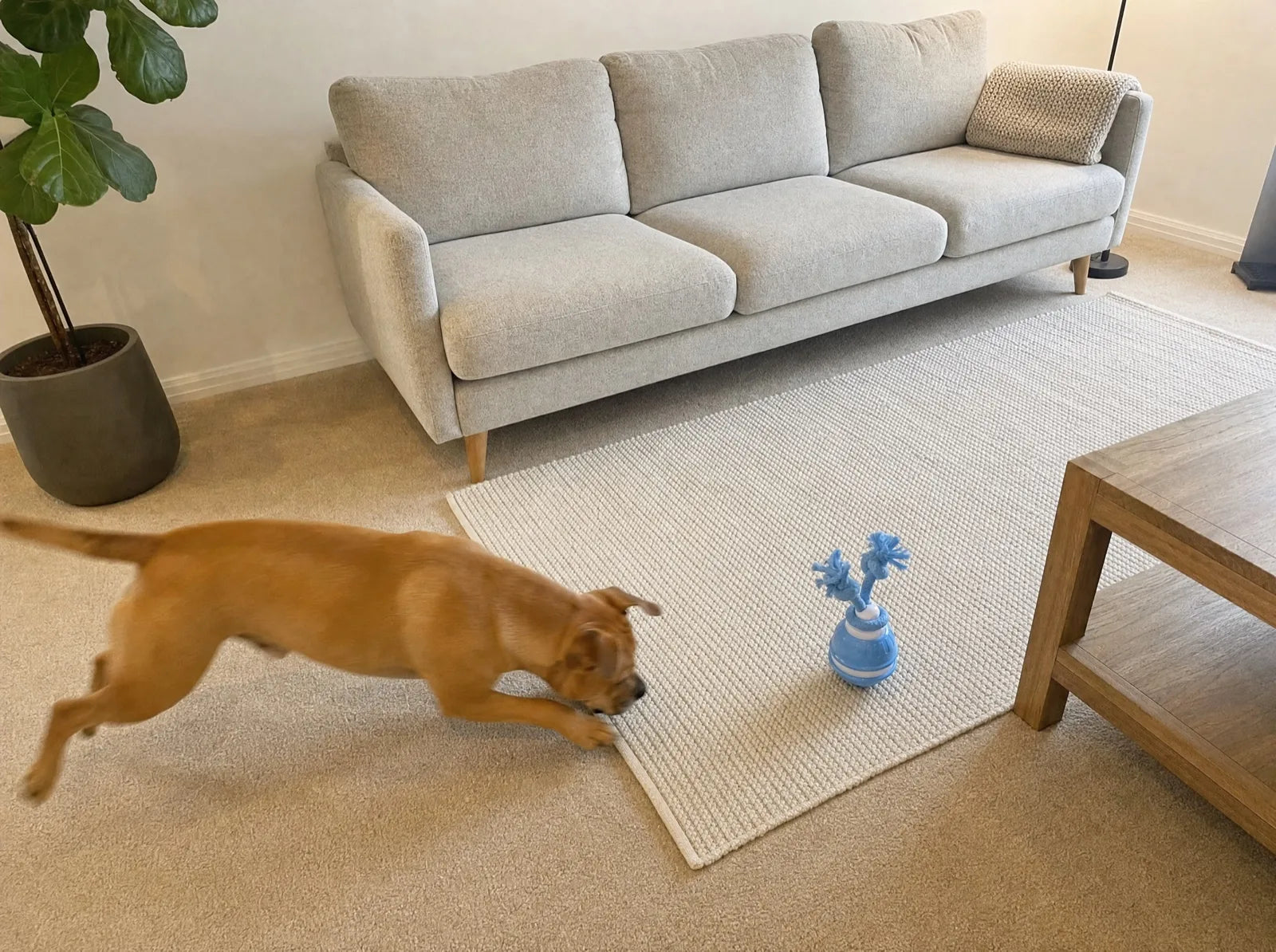
A client brought it to a session. Her Staffy had been a chewer, and she'd stopped needing me. She put a blue ball with two rope arms on my training-room floor and pressed a button.
It's called The Chase Buddy, from a small Australian brand called FloofyPups. They call it "the first dog toy engineered around prey-drive science." I'd normally roll my eyes at that. After watching it for ten minutes, I didn't.

Three ways to get the game going.
Gentle rolling and pauses for the first introduction.
Quicker movement, turns and changes of direction.
Touch reactivation gets the movement going again.
Here's how it stacks up against my list.
Moves on its own. Three modes. Slow Mode for the first few days, where it rolls gently and pauses. Fast Mode, where it cuts sideways, spins, stops dead and bolts. Interactive Mode, which I'll come to.
Moves randomly. The movement is properly randomised. Bruno has had his for months and still can't predict it. That's the whole game.
Reacts to touch. In Interactive Mode it powers down when the dog stops, then kicks back to life when it's nudged. They call it touch reactivation. It's the closest thing to prey breaking cover I've seen in a toy, and it's what gets the grab and the shake done.
Works on carpet. Thick pile, tile, hardwood. It hasn't stalled once on mine.
Survives a jaw. Chew-resistant ABS and TPU shell, reinforced for heavy chewers. Bruno is a Lab. It has marks. It works.
It charges over USB-C in about 90 minutes and gives up to 24 hours of play, which is plenty. Twenty to thirty minutes is enough to burn off the zoomies in most dogs I see.

Free shipping · Ships within 24 hours · 30-Day Happy Dog Guarantee
I'm not the only professional who's noticed it.
"The Chase Buddy is one of the most thoughtfully designed dog products I've seen this year. It actually addresses the underlying behavioural issue, not just the symptom."
Dr. Sarah Bennett, Veterinary Behaviourist, 2026
"This toy has been a lifesaver for tiring our boy out."
"Our Staffy loves his new toy."
"A friend told us about this and it hasn't disappointed."
"Our boy loves it, quick delivery too!"
And if you think your dog is the difficult one, the numbers say otherwise. The Dog Aging Project found in 2024 that 85.9% of US dogs show moderate-to-severe separation or attachment behaviours. Texas A&M researchers found problematic behaviours in nearly every US dog they studied.
4.7/5 from 1,422 reviews · Not sold on Amazon
7. Trying it with a guarantee
Read the offer and the guarantee before deciding.
I recommend a lot of things to clients. Most of them come with a "see how you go." This one comes with something better.
It's called the 30-Day Happy Dog Guarantee. If your dog isn't happier, email them within 30 days of delivery and send the toy back in its original packaging. Once it arrives, they refund the product price. Return postage is the only cost to you. Full terms here.
Fewer than 1 in 50 people ever use it. That number is the reason I'm comfortable putting my name on this page.
The price is $54.99 AUD, and right now it's Buy 1 Get 1 Free. Two for $54.99 AUD. One for the lounge and one always on charge, or one for each dog. Buy 2 Get 2 Free is $109.98 AUD for multi-dog homes.
Shipping is free on every order, they ship within 24 hours, and it's 3 to 5 business days in Australia, 5 to 10 overseas. They send to the US, UK, Canada, Australia and New Zealand.
One thing I tell every client. It isn't sold on Amazon. The cheap copies you'll find there look similar in the photos. They're the straight-line, one-speed, dies-on-carpet balls from point five. The real one only comes from floofypups.com.
Not happier in 30 days? Send it back for a refund.
What I tell clients now
I still tell people to walk their dogs. I've stopped telling them it will fix the chewing.
What I say now is this. Your dog has a hunter's brain and a basket full of things that don't move. Give it one thing that does, that it can't predict, and that fights back when it's touched. Start in Slow Mode, five minutes, day one. Then watch what your dog does when the sequence finally gets to run.
Took me eleven years and a skirting board to work that out. You can skip that part.
$54.99 AUD incl. GST · Buy 1 Get 1 Free · Free shipping
Common questions
Does it really work on carpet?
Yes. Carpet is where the cheap balls die, and it's what this one was built for. It runs on carpet, tile and hardwood. Mine is thick pile and it hasn't stalled.
Is it suitable for my dog's size?
It's safe for small, medium and large breeds. Bruno is a big Lab with a big jaw, and the reinforced ABS and TPU shell has held up.
How long does the battery last?
It charges over USB-C in about 90 minutes and gives up to 24 hours of play. Most dogs are done after 20 to 30 minutes, so a charge lasts days.
How do I introduce it?
Slow Mode for five minutes on day one. Let the dog watch and stalk. Most dogs engage within minutes. Move up to Fast and Interactive Mode over the first week.
What if my dog doesn't like it?
You're covered by the 30-Day Happy Dog Guarantee. If your dog isn't happier, email FloofyPups within 30 days of delivery, send the toy back in its original packaging, and they refund the product price. Fewer than 1 in 50 ever use it.
P.S. Two things worth repeating. It's Buy 1 Get 1 Free right now, so two Chase Buddies for $54.99 AUD incl. GST with free shipping. And it comes with the 30-Day Happy Dog Guarantee. If your dog isn't happier, you can send it back within 30 days for a refund. That's a better deal than any of the 23 toys in my basket came with.
Find Your Dog’s Next Favourite Game →Buy 1 Get 1 Free + free shipping
 2 for 1
The Chase Buddy
$109.98 AUD
$54.99 AUD
for two incl. GST
- Moves on its own, at random, so your dog can't predict it
- Powers down when your dog stops. A nudge starts it again
- Runs on thick pile carpet, tile and hardwood
- Chew-resistant ABS and TPU shell. USB-C, up to 24 hours of play
- Free shipping on every order. Ships within 24 hours
- 30-Day Happy Dog Guarantee. Not happier? Send it back for a refund
- Not sold on Amazon. The real one only comes from floofypups.com